

Presentación de Cuentas Anuales y Planes de Actuación de las Fundaciones

Oscar Andia

Hoy nuestro compañero Oscar Andía Salazar, del departamento de contabilidad de Vázquez Padura Abogados, nos explica la nueva ley de Fundaciones y nos explica cómo realizar la presentación de las cuentas anuales y los planes de actuación de la Fundación en la web que ha habilitado el ministerio.

Essential Tools for Crypto and Banking in 2025

| |

After months of covering fintech disruption and digital banking evolution, we've identified the platforms that are genuinely transforming how individuals manage cryptocurrency transactions and financial compliance.

The convergence of cryptocurrency adoption and digital banking infrastructure has created both opportunities and challenges for consumers. As journalists who've spent years investigating financial technology, we've witnessed firsthand the friction points that emerge when traditional banking systems meet decentralized finance.

In our research, we've identified several critical tools that address these pain points. What follows is our assessment of platforms that have proven their worth in real-world testing—not through marketing hype, but through consistent performance and user trust.

The QR Code Problem: Why Most Crypto Users Get It Wrong

During our investigation into cryptocurrency usability barriers, one issue emerged consistently: the complexity of sharing wallet addresses. A single character error can mean permanent loss of funds, yet most platforms offer clunky, error-prone methods for address sharing.

Enter qrbits.pro, a platform that strips away the unnecessary complexity. After testing it extensively across multiple cryptocurrencies, we found it delivers on a simple promise: instant, error-free QR code generation for any major cryptocurrency.

What We Found

The platform's strength lies in its breadth and simplicity. Whether you need a BTC QR Code for Bitcoin transactions, an ETH QR Code for Ethereum, or a USDT QR Code for stablecoin transfers, the interface remains consistently intuitive.

We were particularly impressed by the support for emerging networks. The ability to generate a Tron QR Code and codes for other altcoins positions this as a tool that scales with the evolving crypto landscape, not just current market leaders.

Bottom line: For anyone regularly transacting in cryptocurrency, qrbits.pro crypto QR Generator eliminates a significant source of user error. It's the kind of utility that should be standard—but currently isn't. Its universal wallet compatibility and instant generation make it an essential bookmark for crypto users.

Cryptocurrency Exchange: Fast, Anonymous, and Secure

One of the most critical challenges in cryptocurrency management is finding a reliable exchange platform that balances speed, security, and privacy. Traditional exchanges often require extensive KYC verification, creating friction for users who value financial privacy or need to execute transactions quickly.

ChangeNow addresses this gap with a streamlined approach to cryptocurrency exchange. The platform operates without requiring account registration or KYC procedures, allowing users to swap between hundreds of cryptocurrencies with minimal friction. In our testing, we found the exchange process remarkably straightforward: select your currencies, enter the destination address, and complete the transaction.

Key Features We Verified

What sets ChangeNow apart is its commitment to non-custodial exchanges. The platform doesn't hold user funds, instead facilitating direct peer-to-peer swaps. This architecture significantly reduces security risks associated with centralized exchange hacks and custodial vulnerabilities.

The exchange supports over 850 cryptocurrencies and tokens, with competitive rates and transparent fee structures. Unlike many competitors, there are no hidden charges or surprise deductions—what you see during the quote process is exactly what you receive. Transaction speeds are generally fast, with most swaps completing within 5-15 minutes depending on blockchain confirmation times.

Bottom line: For users prioritizing privacy, speed, and simplicity in cryptocurrency exchanges, ChangeNow delivers a compelling solution. The no-KYC approach and non-custodial architecture make it particularly valuable for experienced crypto users who understand the importance of controlling their own assets.

Canadian Tax Season: CRA's Digital Infrastructure

For Canadian readers managing cryptocurrency holdings alongside traditional income, tax compliance has become exponentially more complex. The Canada Revenue Agency has expanded its digital services, but navigating the fragmented login systems remains challenging.

Whether you're filing personal taxes, managing business accounts, or representing clients, understanding the CRA's access points is critical. The following resources provide direct access to the systems you'll need for 2025 tax filing, refunds, and deductions management.

Business Banking: Payment Processing That Actually Works

For businesses operating at the intersection of traditional and digital finance, payment processing infrastructure becomes critical. We've evaluated platforms that bridge this gap effectively.

Bambora: Enterprise-Grade Payment Solutions

Bambora's merchant services platform continues to demonstrate why it's become a staple for Canadian businesses. The platform offers robust payment processing with particular strength in multi-currency transactions—critical for businesses serving international clients or accepting cryptocurrency conversions. Whether you need to access the Bambora login portal for merchant account management or configure payment gateways, the system delivers institutional-grade reliability with startup-level agility.

RBC Express: Canada's Largest Bank Goes Digital

Royal Bank of Canada has invested heavily in digital infrastructure, and RBC Express represents their commitment to streamlined online banking. For users managing diverse financial portfolios—from traditional investments to cryptocurrency holdings—RBC's comprehensive platform offers the institutional credibility and robust security features that matter when significant capital is at stake. The Express login system provides quick access to business and personal banking, investment tracking, and cross-border transactions.

Servus Credit Union: Community Banking for the Digital Age

Credit unions often struggle with digital transformation, but Servus has managed to maintain the personal service of community banking while delivering competitive online infrastructure. For individuals managing both traditional savings and cryptocurrency holdings, having a reliable credit union account provides essential stability.

Access Servus Online Banking →

DBS Bank Singapore: Asia's Leading Digital Banking Platform

For businesses and individuals engaged in cross-border cryptocurrency transactions and international finance, DBS Bank Singapore has emerged as the region's most progressive institution. Named "World's Best Bank" multiple times by Global Finance, DBS has pioneered digital asset custody services and blockchain-based payment infrastructure. Their digital banking platform provides institutional-grade security with seamless integration for wealth management, trade finance, and emerging digital asset services. The DBS SG online banking infrastructure makes it an essential partner for anyone operating in the Asia-Pacific fintech ecosystem.

Allica Bank: UK's Business Banking Innovator

For businesses operating in the UK market, particularly SMEs navigating the complexities of modern commerce, Allica Bank has emerged as a refreshing alternative to traditional business banking. Built specifically for established small and medium-sized businesses, Allica combines the personalized service of relationship banking with cutting-edge digital infrastructure. The platform's strength lies in its specialized focus on business clients with turnovers between £1-25 million, delivering tailored financial solutions that legacy banks often overlook. Through Allica Bank Login, businesses access comprehensive account management, commercial lending, and treasury services designed specifically for growth-stage companies.

What sets Allica apart is its hybrid approach: combining digital-first efficiency with dedicated relationship managers who understand sector-specific challenges. Whether managing cash flow for seasonal businesses, handling multi-currency transactions for importers, or coordinating payments for property portfolios, the Allica Online Banking platform delivers the sophisticated tools businesses need without the bureaucratic friction of high-street banks. For companies dealing with cryptocurrency vendors or international digital payments, Allica's progressive approach to fintech integration makes it a valuable banking partner.

The Bigger Picture

What unites these platforms is their focus on reducing friction in financial operations. Whether it's eliminating transcription errors in crypto addresses, streamlining tax compliance, or providing reliable payment processing, each tool addresses a genuine pain point in modern financial management.

As the lines between traditional finance and decentralized systems continue to blur, having reliable tools across both domains isn't just convenient—it's essential. The platforms we've highlighted here represent the kind of infrastructure that makes that hybrid financial life manageable.

About the Authors
Jacob Silverman
Freelance journalist and podcaster covering tech, crypto, politics, and corruption. Regular contributor to major technology publications.
Alex Morrell
Senior correspondent at Business Insider covering Wall Street, fintech, and banking infrastructure.

La nueva ley de Fundaciones

Desde el pasado 1 de diciembre de 2016 es obligatorio que las Fundaciones presenten de forma telemática sus cuentas anuales y planes de actuación a través de la aplicación informática que el Protectorado de Fundaciones ha puesto a disposición de todos los usuarios dentro de la página web del Ministerio de Educación, Cultura y Deporte.

Recordemos que en el caso de las cuentas anuales y del informe de auditoría en su caso, tenemos seis meses desde el cierre del ejercicio para su aprobación por el Patronato. Tras la aprobación de las cuentas, debemos presentarlas en el protectorado dentro de los diez días hábiles siguientes a su aprobación.

¿Como presentar las cuentas anuales de la Fundación?

Lo primero que debemos de hacer es, si todavía no poseemos las claves de usuario y contraseña, es solicitarlas a la siguiente dirección de correo electrónico cuentas.fundaciones@mecd.es

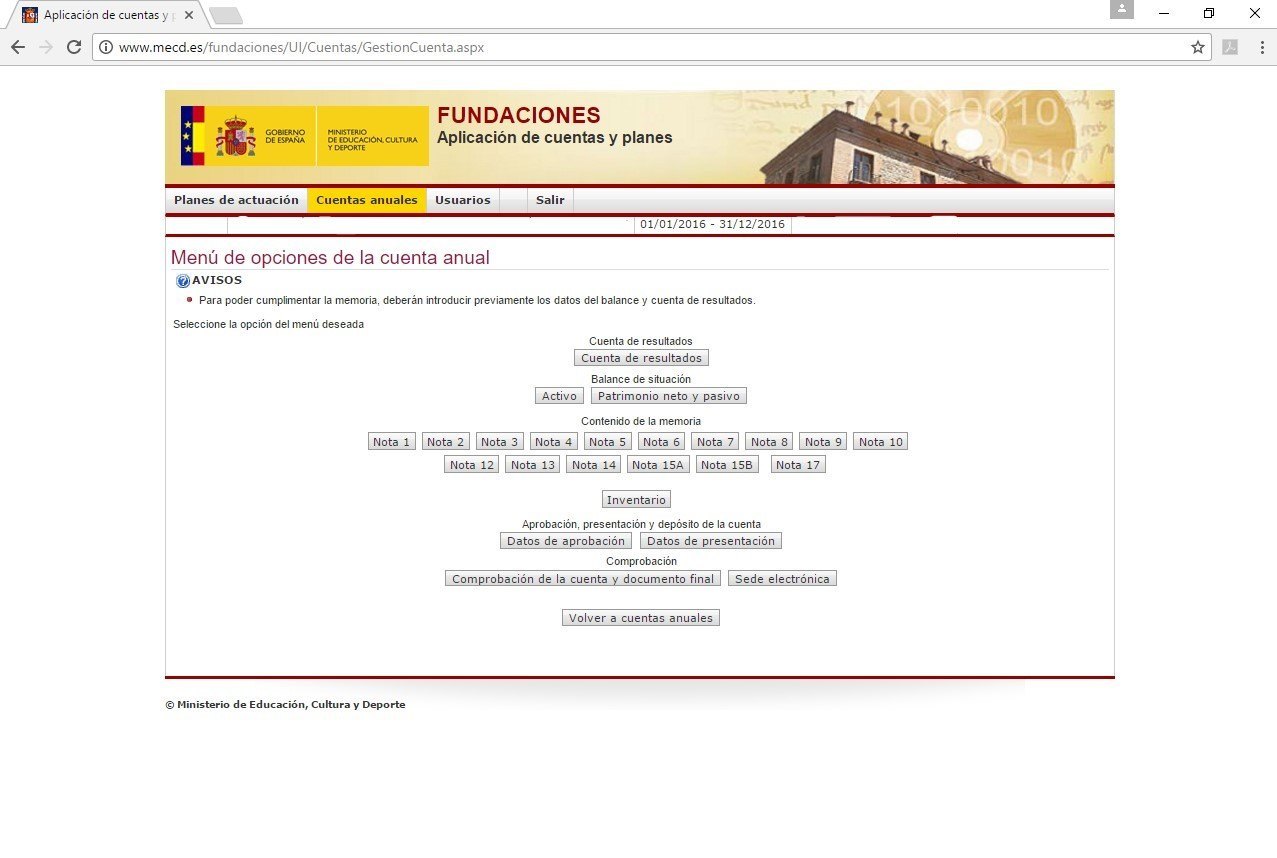
Una vez obtenidas estas claves tenemos que ir cumplimentando paso a paso todos los apartados de la memoria comenzando por el balance de situación y la cuenta de resultados.

En la imagen a continuación observamos el  menú con los diferentes apartados que tendremos que cumplimentar.
fundaciones cuentas

En todos los apartados en los que nos indique que la información es obligatoria de cumplimentar y nos encontramos que nuestra Fundación no tiene nada que informar al respecto podremos poner N.D. (No declara) y a continuación debemos de ir guardando siempre todos los cambios para que automáticamente los vaya incorporando a la memoria.

Aunque a priori parezca una labor complicada, lo que estamos haciendo es simplemente informar a través de la aplicación informática de todos los datos que anualmente incluimos en la memoria económica,  y con una notable ventaja que es asegurarnos de que no cometemos errores en la aportación de la información económica, puesto que dicha aplicación nos va informando en tiempo real si hay algún dato erróneo.

Una vez que hemos cumplimentado todos los apartados debemos chequear la memoria  en el apartado Comprobación de la cuenta y documento final, si hay algún error nos indica en que nota de la memoria se encuentra y pinchando encima del mismo nos dirige al error para poder subsanarlo.

Cuando todo está correctamente informado, debemos generar tres archivos en formato pdf compuestos por las Cuentas Anuales, el Certificado Acreditativo de la Aprobación de Cuentas y la Hoja de Firmas. Estos tres documentos son los que debemos presentar en nuestro Patronato para que en el caso de las Cuentas anuales y el Certificado lo firme el Presidente y el Secretario de la Fundación en todas sus hojas y la Hoja de firmas la firmen los miembros del Patronato.

Finalizando la presentación de las cuentas anuales de la Fundación

Cuando tengamos todos los documentos firmados, desde la web de la sede electrónica del Protectorado, con el certificado digital del Presidente o del Secretario, podremos ir incorporando los archivos que generó la aplicación  en formato pdf y que han sido firmados por los miembros que componen el Patronato de la Fundación y posteriormente hemos vuelto a escanear, así como si tenemos informe de Auditoria y si es necesario incorporar algún otro documento.


Busca aquí
Categorías
Últimas entradas

Tambien puede interesarte...